From Programming to Leadership, a Story of Burnout
~4 min read
Jump to end ↓

Some years ago, when I was transitioning from the role of Individual Contributor to Lead, I nearly burned out and resigned.
It went like this. I had a weekly scheduled meeting with a senior leader on the game I was working on. I appreciated his mentoring in some things and his experience. He noticed I was complaining again and again about the same things, over and over, week after week.
I was full of rage, sometimes angry, sometimes in despair. My mood was volatile. I was facing conflict, and just disagreeing in general with another part of the organization that I could not resolve or get over with. I was losing sleep over it but I was fighting. I was writing long emails, rallying troops, making plans, explaining the how and the why. I was still succeeding in what I wanted to achieve and rebut.
But I was also on the verge of quitting every day.
 A very serious man at Ubisoft
Transitioning from an individual contributor position to a leadership role is one of the most rewarding but risky things you can do.
This guy told me that about 12 years into his career, also transitioning from IC to lead, he had faced the same turmoil. In retrospect, I think that’s very common.
Imagine yourself: driven, ambitious, a high performer.
- You have attention to detail and you care. You are personally invested.
- You are outcome-oriented.
- You are resilient.
- You can jump on very different problems; you learn and understand complex interactions.
This is you as an IC. Now as a leader, all those qualities, all that strategy, will turn against you. In other words, what made you successful yesterday is not the same thing that will make you successful tomorrow.
As a leader, your scope suddenly expands from your specialty to wherever your team needs you, very often outside your niche. For me, I was a network programmer, and suddenly I was managing gameplay and engine people.
- You don’t control the output directly; you delegate to your people.
- You try not to micro-manage, but every inch of your brain tells you to get involved in the architecture and the subtle details.
- You have so many things happening at the same time; you can’t go deep on everything.
It just can’t work. Maybe it will for a time, but at some point you will explode.
You can use your strength and technical breadth on some project that you deem important, but as a good producer (if they exist), you constantly need to triage. You triage everything that comes your way: is it an HR issue, is it just listening to someone’s pushback, is it a new feature that needs love? Can you delegate it, should you do it yourself, etc?
The magic of triaging is that you need to be honest with yourself: if you accept to let go of something, you really let go. I had to fight myself, while eating, brushing my teeth, to forbid myself from thinking about work, because it would eat me alive. Protect your safe space at all costs.
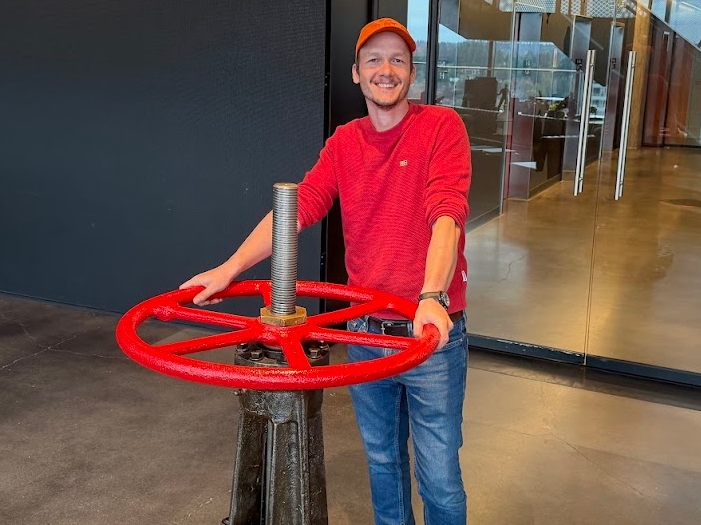 Cranking the valve of success
When you’re on edge, when you’re overwhelmed, you tend to take everything personally. After all, you became good because you cared deeply about your craft. It’s the difference between searching for greatness and having a job. You want to be the best. The problem is that now you’re judging all your interactions with others by the same standard.
You need to be there, otherwise they may get it wrong. You need to be there, because you know better. You need to be there because you are the man.
But you’re not the man anymore. You’re not hot anymore. You’re a super facilitator. You’re a multiplier. You’re growing a team. You cannot break their dreams; you need to make them dream. Leadership is sometimes a bit solitary in your struggle.
This is the real trap: you have to dissociate your identity from your work. I could have led with this, but it’s the hardest part, maybe the hardest thing a technical person learns. You have to.

Three rules that helped me:
- Things are usually not personal, and people don’t have malice. Allow the reset of relationships.
- You can’t control what someone else does. Only what you do.
- What’s already done is done. Don’t dwell.
I managed to temper my frustration, my rage, the anger, and ultimately the unhappiness into something more balanced.
I wish it for you too. Let it flow over you.