Reflecting on my Leadership
~13 min read
Jump to end ↓
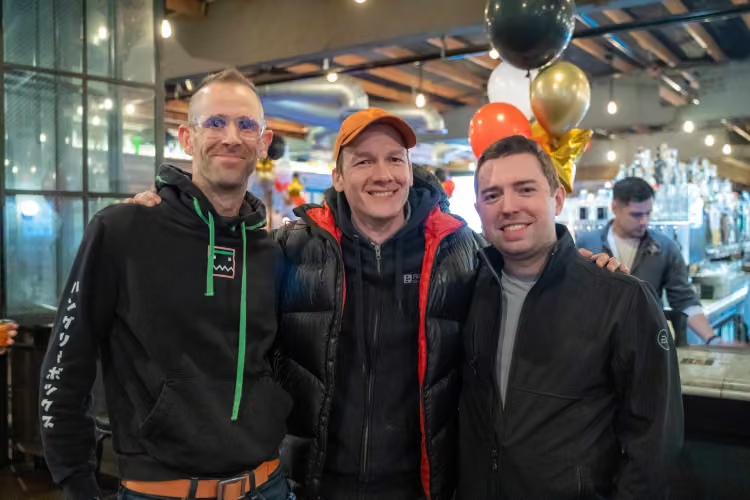
Having trained a lot of newly appointed technical leaders, I am reflecting on what has succeeded and failed for me so far.
I am now a Principal (btw) Technical Director. It mostly means I am the lead of other directors. My organization has roughly 60 people in it.
I joined Respawn in February 2020 after 5 years at Microsoft working on Gears Of War. I had two motivations for joining:
- Work with world-class people.
- Become a lead.
Both turned out to be true.
Vancouver had started to feel small and working on Gears was becoming a bit stale. The games were perfectly fine but not ambitious enough for my taste. I had shipped a very hard feature (killcam) and it was the peak of my accomplishments there. I was not on a path to a leadership position because opportunities to differentiate myself were not plentiful. The problem with a company like Microsoft is that usually upward mobility is very limited as people tend to just stick with the company forever; so, good luck getting those principal or leadership roles. That being said, I learned a tremendous amount about the kind of leader I wanted to be there ( Brennen, Rayner). Both were extremely impressive in their humanity and self-control, being able to extract the best out of people during tense moments.
Some Microsoft things:
- Brennen on accountability and responsibility: “It is extremely easy to go gambling when it is not your money”. It is about when you take risks potentially impacting users. It is easy to think abstractly and virtually in our day-to-day, but you do have a responsibility regarding risk mitigation and the impact of your changes. It is a good mantra when you want to go fast, sometime recklessly.
- I had a review that read: “You should respect your Seniors’ opinions more”. I know exactly who it was and it still makes me chuckle. At the end of the day, respect your lane and your reporting duties, but push forward (I have tense stories I cannot share here).
Respawn had a fantastic reputation. My boss was going to be Jon Shiring, a celebrity in his own right. Sadly, he decided to leave when I joined to create Gravity Well. The team at the time had roughly 22 engineers, I believe. To become the best, it is way easier to get good mentors. I took as much learning as I could from him, but to my delight, I learned a lot from others who were also exceptional individuals and leaders (Kalas, Baker, Barb, Earl).
 My desk, more than 10 years ago at Ubisoft
Road to the First Leadership
I got my first leadership position in November 2020 (same year), roughly 6 months after joining. Initially, Respawn was too small to have leads, but given the success of Apex Legends, the company was hiring and expanding. I will not get into the details, but I arrived at the right time. Whereas Microsoft had no new open positions, Respawn had plenty of opportunities: starting small and growing.
I worked extremely hard to get noticed.
- I was already productive within the first week of joining. I would describe myself more as a hacker rather than an architect. I am very good at getting into big systems and understanding the dependencies and the flow of data to be able to modify them. I think this is in big part due to starting my career at Ubisoft on giant game engines like Assassin’s Creed. It is a skill to develop.
- I had one of the highest bug-solving velocities. Every day I needed to close something. It meant some days were extremely packed and intense, while some days were extremely chill if I was doing something simple. I learned very early on, again at Ubisoft working on a 1-year project (the most insane crunch you can imagine), how to pace myself. You very often see Jr profiles give it their all and burn out after just a year; not me. Alternate simple stuff with hard stuff; it will keep a good balance of reward and sweat for your brain.
- I pitched a lot of features that got made (reconnect and performance display, for example). You want to be a problem solver for others. The core of the business is to solve product problems, not technological ones. If you can answer those and execute, you will gain a lot of support. The story of reconnect is very simple: at launch, Apex used to crash a lot and you would not be able to reconnect to the game. I pitched it to my lead while still doing other things and it finally shipped.
I honestly do not remember much about with whom or what I was doing at the time (I think my first team was called Core-Tech). The company was going through a tremendous amount of changes. During those times, expectations, roles, and missions changed. I remember seeing a talk last year from one of the ex-Riot CTOs, Mike Seavers, explaining they went through a similar transition at the time. You have to transform an organization where most people are self-organized and work on their immediate feel for what is impactful. You can achieve a lot like this, but it does not scale. So, when those companies grow, the governance model changes with great friction. This CTO was saying that roughly 80% of the leadership at the time could not adapt to the new paradigm. It is extremely relatable to me. In general, when you get used to a way of doing things, pivoting or accepting doing things differently is met with great resistance. It is very hard for a lot of people to project themselves differently. You get trapped into thinking there is only one way to achieve your goals. In truth, there are as many ways as there are different companies.
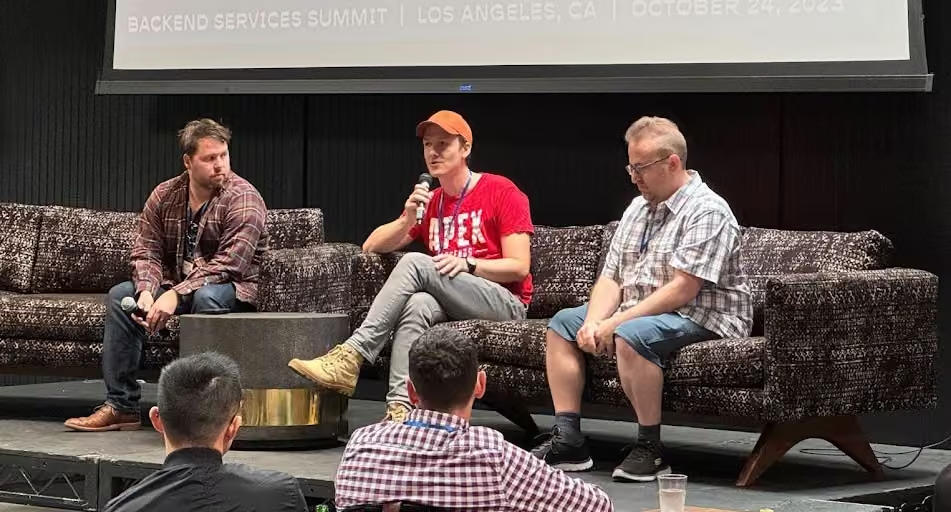 Giving a talk about Matchmaking at Pragma 2024
Road to Technical Director
I became Technical Director by lobbying, through another Technical Director ( Jon Carr), the CTO of the company at the time, Fred Gill. They are both awesome people from whom I learned a lot. Jon is currently CTO at Giant Skull, cooking something in Dungeon & Dragons land, and Fred is half-retired (he cannot stop working). The point being, the higher you get, the more support you need to advocate for your work. A lead role or a technical leadership role is not something companies usually are willing to take back. It is extremely rare for someone to take a demotion; more often than not, you would get laid off if you are not performing in a role. Therefore, those steps and promotions are extremely hard to come by because if it fails, it is fatal. You need to build this trust and confidence that you will actually succeed and get advocates for it. Also, as a technical director, you get more weight particularly when interfacing with people outside your organization, so you can pitch your promotion around those collaborations.
The transition from lead to director is as big as from IC (independent contributor) to lead. You get more exposure to Sr leadership, and you actually need to have product opinions, something that as an IC, you are not really being asked about.
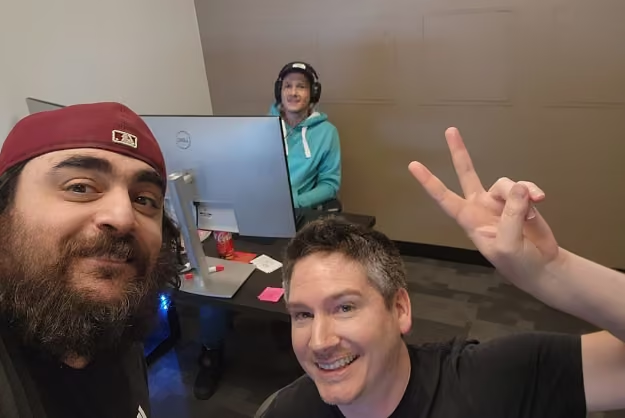 Respawn, my closet office with two annoying people
A Word on Producers
Producers are strange animals that you need to deal with to succeed. They will tell you if there are dependency problems between teams, try to align the roadmap of a lot of moving pieces, keep your backlogs clean, help you to triage as a first line of defense, and so on. They will also build a different rapport with you and your team members, bringing a fresh perspective to some complex interpersonal dynamics. It is one of the great joys of working in video games: you get to work with people with very different backgrounds and skills. You need those to make great things. The producer is a day-to-day embedded human in your engineering org that is not an engineer. I cannot stress enough how important it is. More often than not, they have some product sense. They are not there to make technical decisions or manage people; as a word of caution, it is a line that can be easily crossed and can be the principal source of tension between you and them. If you are vigilant and very clear about your expectations, they will be a force multiplier in your org that you cannot do without. I had great luck in my career to work with good people from whom I learned a lot: Matt, Leo, Jordan, Janessa, Xander, and others. To be successful, you need to know which data you want from them: they may tell you, but sometimes you need to ask. Also, do not keep the work abstracted from them. I try to explain the technical bits as much as I can. They are part of the team; you need to help them integrate into a world that is a bit hostile (engineers love their jargon).
For example, with any team I take over (basics of the basics), I ask what the delta is between estimates and how long the work actually takes. Sometimes, roadmaps are built upon estimates but are never revised when the work is done. It is extremely dangerous because if you go back, you will never actually see the true cost of a feature. For me, this is what production is about: they are your anchor in reality. They keep you accountable on the timelines but also help you to understand what happened when you over-achieve or under-achieve. You will be a tremendously better engineer if you are able to estimate your tasks properly. First, because the more you can project into the future, the more you will be able to detect dependencies and problems, allowing you to have a larger vision of what you are doing. This will inevitably lead you to think more about the actual goal of what you are doing rather than the task-to-task. Second, being aware of time, you can make effective choices: do you go for the deluxe version or the fast one? Do you have time? Does it matter? When you are in it, you will have tunnel vision, your doubts, and some anxiety. The producer will pick you up and put you back on track. This data can be self-served, but that is not the point. The point is that the producer will help you build this culture around performance, transparency, and goals (does the work I am doing matter). It will transform your team into a success machine, guaranteed.
Note: Engineers usually by default resist the transparency part: estimates and commitment. It is normal; people do not like scrutiny and making choices. This is the transformative culture part leads and producers are here for. I saw that firsthand when transitioning from Gears 4 to Gears 5. On 4, we crunched a lot, then on 5, we got a new head of production, Christi Rae, who managed to push for this cultural shift. We did not crunch on that game, lesson learned.
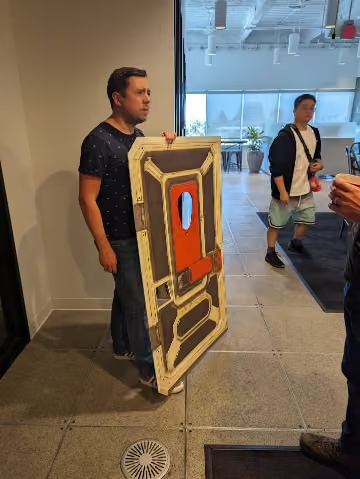 Conger telling the story of an Halloween costume
Random Advice
I spoke a lot about history but little about recipes.
I divide and conquer. My end goal is to be useless. The teams need to run without me. When I incorporate a new team under my org, I manage it personally. I work closely with production about what I want to see (estimates, velocity, triaging). Then I will implicate a lead whose mission is to take over gradually from me. The mission needs to be defined. It does not mean we know what to do, but we know the effect we need to have. It is very different. Most engineers have problems articulating a product mindset. You constantly need to get new ideas to try to get to the effect. In our case, an effect is usually a user story. You put the player experience first and center: you try to solve a problem for them. But to do so, you need to articulate a strategy that will translate ultimately to technical challenges, tasks, and work. It also means if the desired outcomes change, you accept to pivot.
To encourage innovation and new ideation to come about, I have multiple cross-team idea incubator meetings. People just sit there and discuss amongst each other. Sometimes people just exchange information about the project or features they are working on. But sometimes, a little spark will appear, or some recurring problems being discussed on a tangent will lead to new ideas. This is exactly what you want: you want to collect those ideas. In time, you will build a database that will help you make the product better (always have an idea ready to go).
Let people know where they stand. You want everyone to succeed but you need to have those conversations. In general, sadly from my experience, people are really not self-aware of:
- Their performance
- The image they project to others
Transparency is very important. You need some metrics to put your own bias in check. You also need to differentiate performance between members of the team. You will not build a high-performance environment if everyone’s rating is the same. You need to champion the culture you want to see. I even gave homework (optional) to team members to improve some technical gaps they had.
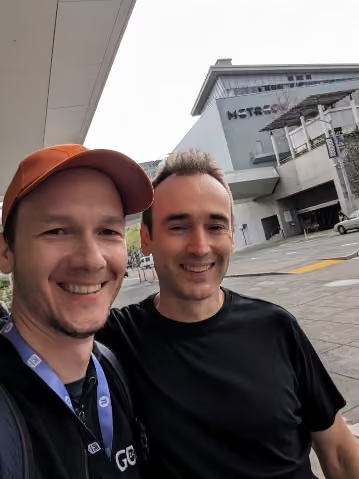 MacKey, one of the best designer I know
What I tell my teams is: if you work with me, when you leave my org or the company, you will be a better engineer than when you started. It also means, as a leader, you need to keep your own skills in check. A producer at Ubisoft told me a long time ago there were mostly 2 families of technical leaders:
- Political: delegate a lot but able to manage large groups.
- Technical: you keep your skills as if everyone had to be let go, you would be able to maintain the game by yourself.
Usually, you will want to be both, starting with technical and slowly becoming political. With experience, you need to elevate a lot of people with you beyond a pure understanding of the technology.
Favors and special accommodations usually blow up in your face. You always pay for it in some shape or form. Establishing consistent decision-making, particularly for HR-related topics, is good for you and for the team. Again, it is about the transparency of the data and decision-making. It is also how you build trust.
Always give credit where credit is due. We work in an industry that is relatively opaque and project-based. After a game is shipped and gone, it is nearly impossible to tell who did what and how it happened. Being transparent and faithful about credit recognition is part of letting the legacy and merits of deserving people live on, no matter what their title or role was. Never work with people who do not give correct credit. It is why I overly name drop people, always.
I try to be as candid as I can, over-sharing. English is not my mother tongue, and the default American work culture is not my culture. It is way simpler for me to be direct and candid. You own your success and your failure, I will not sugar-coat it too much but mostly because it would be hard for me to articulate it in any other way. I am not saying it is the only way. I would often, use others, maybe more eloquent to inspire or transmit information. I can be seen as clumsy or funny at time, this caused sometimes great distress in my life.
And finally, after all this verbiage, do not hold grudges or let your temper get the better of you. My mom is Italian and I got this hot-blooded temper from her. I can get angry, frustrated in a quarter second. It is not new information, I know that and what I need to do to not impact my work-life. Do not send angry email or messages prematuraly, do not hold grudges. People need to know that you can reset your relations despite tension. Being human and forgiving, you have been given some amount of power but more particularly responsabilities, duties toward people that you represent; there cannot be no pettiness when the stakes (people’s livelihood) are so high.
Be good.
 A meme about me mowing grass.