Shooting Guns and Philosophical Ramblings
~9 min read
Jump to end ↓
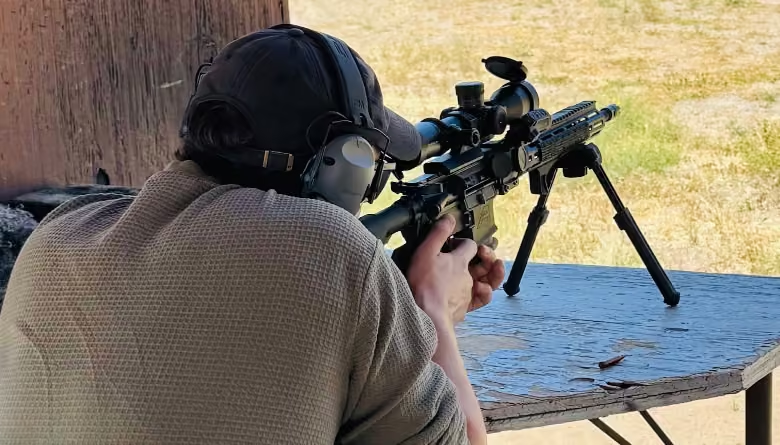
A friend offered me a day of initiation to firearms. I jumped on the occasion, since I had never really touched a firearm in my life before.
No, this is not a surprise reveal of me being a gun nut. But to be fair, whenever I get the chance to learn a new skill, I take it. Horse riding, shooting arrows, sewing cloth, or building a table; I would do all of them without hesitation.
Learning Skills
For example my awesome sister offered me a day with a blacksmith to do a knife from scratch; intense but so cool.
I had two prior experiences shooting firearms, and they were both at Battlefield Las Vegas. It is a bit the Disneyland of firearms. You can rent a tank to crush a car, a helicopter to shoot at targets in the Nevada desert, or just shoot fully automatic weapons in an indoor range. Being a gamer and history buff, I mostly shot historical weapons like the MAT-49 and other old stuff. The Disneyland aspect is that you never actually handle the gun yourself. It is loaded and placed in your hand by a weapons officer, and off you go. Completely on brand with the Las Vegas entertainment concept. They even pick you up at your hotel in an Humvee if you want to live out the Desert Storm experience while wearing shorts.
Shooting a Kar98K before seeing The Strokes & the RHCP the same day, Las Vegas in a nutshell
Usually, the canonical response from the family is indifference. My dad said, “I would prefer you play with carabiners (climbing gear).”
There is fundamentally a difference in how firearms are perceived on both sides of the Atlantic. I think it boils down to utility versus leisure.
Utilitarian
The utilitarian view is usually centered around self-defense or home defense. For French people, this is not a compelling argument. It is very well established that the police holds the monopoly on legal violence, and this is a core tenet of the French Republic. Many thinkers have written about it, such as Bourdieu (in On the violence of the state) and Foucault (in Discipline and Punish). I love Foucault a lot, even if it is a somewhat sensitive reference, because he theorized about the transition from very public violence, think public executions, the king’s right of life and death, to something regimented and codified through a bureaucratic process in modern times. The police are the agents of this.
French people do not really like their police because they are perceived as such: the armed expression of state power. This was particularly evident during World War II, when the police collaborated with the occupant to repress and kill members of the French Resistance, acting as the armed arm of the collaborationist Vichy government. In this conception, there is simply no place for an individual right to violence. Of course, this is very different in America. In France the state is everything, the guarantor of order. Americans have a far more decentralized view of power and liberty, particularly through a Constitution designed to keep potential government abuse in check.
Maybe this is a superficial take. I have not read many American philosophers, but I can sense it from my day-to-day experience over there.
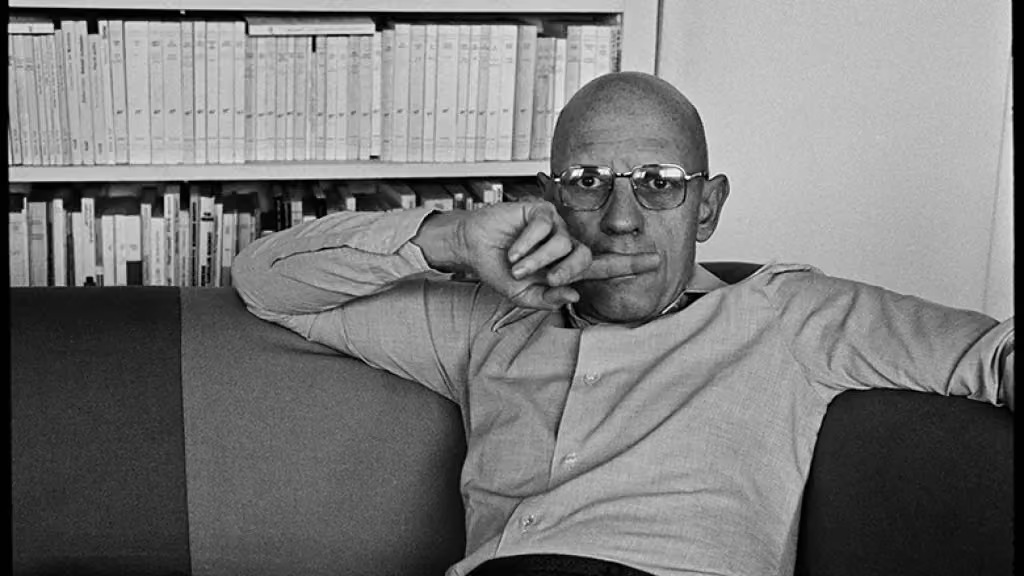 Foucault, typical French intellectual
A game
Then again, firearms are not a game. If you look at Olympic shooting, the rifles look less like weapons and more like measuring instruments: instruments of extreme precision. I do not think firearms enthusiasts enjoy watching those events very much, because going to a gun range looks nothing like what happens on Olympic TV. Yet there is another sport that shares this same DNA of precision and concentration: archery.
I think archery and competitive shooting represent an inversion of the firearms hobby. With guns, the mainstream culture leans utilitarian or tactical. The sport itself is the niche interest, usually pursued by a specific community. Archery flips this. The sport is the draw; the historical and utilitarian aspects, reenacting old practices and hunting, are the niche pursuits. The core appeal is the same: discipline, focus, and the refinement of technique. But the surrounding culture sits on opposite sides.
Funny enough, my favorite winter Olympic sport is the biathlon, because it is the only sport that somehow reconciles both worlds, even if I am personally less drawn to that side of things.
 Imagine sprinting on skis, then having to take a bulls-eye shot
That being said, France has one of the highest weapons-per-capita ratios in the European Union, thanks to hunting. It is a different fantasy, and my family has always been very critical of it. Let us not dwell on it, but just so you have a mental image: there is a political party in France literally called “Chasse, Pêche, Nature et Traditions” (Hunting, Fishing, Nature, and Traditions), imagine old folks eating sausages, smoking pipes, and drinking red wine while hunting pheasant.
The Army
Also, France used to have mandatory conscription. Every able-bodied man before my generation served at least a year under the flag. My dad was a sniper in the Alpine troops. My grandfather was a mechanic during the Algerian War (a terrible decolonization war), and all his brothers served too. I am not even speaking about the ancestors lost during both World Wars. There is no levity to find there. Service also gets little recognition. It is just something you have to do, and everyone did.
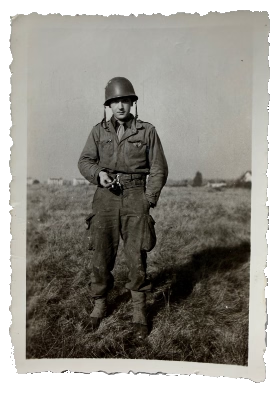 Papoune in 1958
Conscription was abolished in the late 1990s, and the French army shifted to a professional force. What survived from the old system is a one-day call under the flag; and that is what I experienced. One day is nothing compared to a year, but it is still a day you cannot miss. Contrary to conscription, it is open to women. If you do not get your paperwork in order, you may be unable to graduate or get your driver’s license. You have to report to the closest army garrison. For me, it was Valence, and the Spahis. The Spahis are a unit of light cavalry that fought bravely in World War II in the Ardennes, Syria, and Palestine. Nowadays they operate light tanks and armored cars. During this day, you attend classes and pass some tests. It is one of the last occasions for the education system to detect illiteracy, for example.
I will always remember how dumb I was at the time. Mind you, I was 18. I was extremely into political activism back then. I was a proud card-carrying member of the Socialist Party and campaigning for Ségolène Royal, who could have been the first female French president. She lost to Nicolas Sarkozy later that year, who would go on to become the worst president of the Fifth Republic. Ségolène Royal has also, in more recent years, proved to have extremely bad ideas. Between the two, it was a bad roster for presidents. Let us not dwell on French politics. The point is, I was not exactly receptive to the army’s message. I wrote on the back of my evaluation sheet: “Interesting speaker despite the propaganda effort of this exercise.” I was sitting at the very back of the class, and when the recruiter started reading the feedback aloud from the papers, mine was the first. He read it to the whole class, became furious, and then dismissed us. I feel embarrassed about it, because I undermined someone’s idea of purpose and dedication, someone who had obviously dedicated his life to it, at the hands of an 18-year-old who knew nothing.
I regret it.
 Nicolas Sarkozy & Ségolène Royal
The Range
I made a parallel that my friend and shooting instructor appreciated: I compared the maintenance and firing of a firearm to the discipline of climbing. There are few accidents, but they all have terrible consequences. You repeat the same technical manipulations and checks over and over, until one day you forget.
We shot a .22 rifle to get a feel for it. We also had a Walther PDP, a Glock 17, and a Glock 19. The Glock 17 and PDP felt too big for me; I have small hands 😏.
Then we moved on to shooting two AR-15s, each equipped with a different scope. Mind you, this was my first real day handling a firearm. Everyone at the range talked about regulations and how California’s gun laws don’t make sense. I get that regulations are imposed on your hobby, but when it comes to rifles, it is crazy.
I had a very hard time hitting a target with a pistol. It is quite technical: hand placement, sight alignment. But an AR-15 with a red dot? I was getting 10/10 hits on a target at 200 yards. It was as easy as point and shoot. We tried 400 and 500 yards, calibrating the scope and accounting for the wind. That is clearly a different sport altogether. But under 200 yards, it feels like a very dangerous toy, given the lack of training you need to be effective.
Shooting red dot at 200 yards
Cop stance
At the end of the day, I loved the mechanics. I loved the discipline, the ethics of not messing around with something dangerous. I do not have a burning desire to shoot a target dead center, but actually having proper stance and good technique is very appealing to me. I am sure I would love archery for the same reasons. I love antics, history and tradition behind things. If i had a gun, I would certainly find niche and old collectibles.
Also, because of California, people are pretty shy about saying they love this sport. That is why I removed the audio from the range videos. I think it is a shame not to be able to share your passion. When you do not speak up, you leave room for the most extreme viewpoints, voices that lack this kind of self-awareness, and that can drown out more reasonable perspectives. This is true for everything, really.
As far as I am concerned, I had a great time with a friend, someone trusting enough to share his passion and his knowledge with me.
It brought me a lot of joy.