Remembering a Trip to Yudanaka
~5 min read
Jump to end ↓
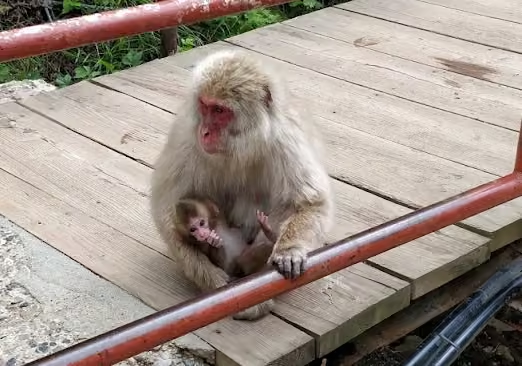
Years ago, I took a trip to Japan with a close friend. We eventually found ourselves in an old mountain town, tucked away in the heights and surrounded by snow monkeys.
The town is called Yudanaka. It sits at the end of a local train line that winds up from Nagano. In my mind, Nagano has always held a certain mystical appeal. It was the host of the 1998 Winter Olympics. I was ten years old and big on skiing. That was the year France won the soccer World Cup, Philippe Candeloro, a male figure skater was at the top of his stardom by taking the Bronze with his legendary D’Artagnan program. I remember being glued to the TV.
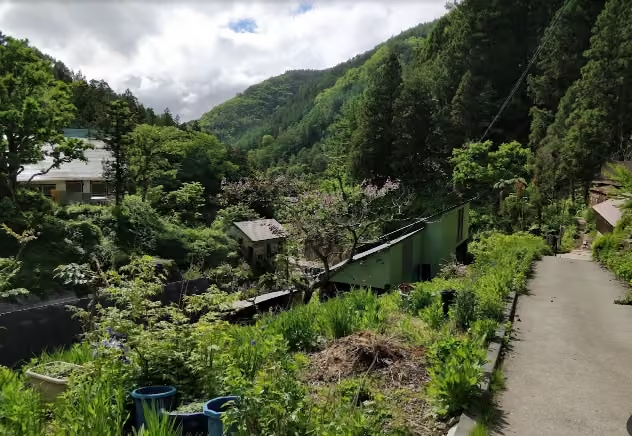 Bucolic landscapes on the way up.
My friend wanted to see Kanazawa, which sits on the opposite coast from Tokyo. To get there, you take the Shinkansen on a line that passes through Nagano. After we did our sightseeing in Kanazawa, including the famous Kenroku-en garden, we doubled back toward Nagano. From there, we hopped on a local train that crawled through tiny villages, sprawling fields, and quiet cottages until we reached the end of the line: Yudanaka.
There are two main attractions there: a communal Onsen built in the 1930s, and a mountain park reachable by a scenic hike where you can find some snow monkeys bathing in the heat. The town itself is small and has a cozy “mountain cabin” energy.
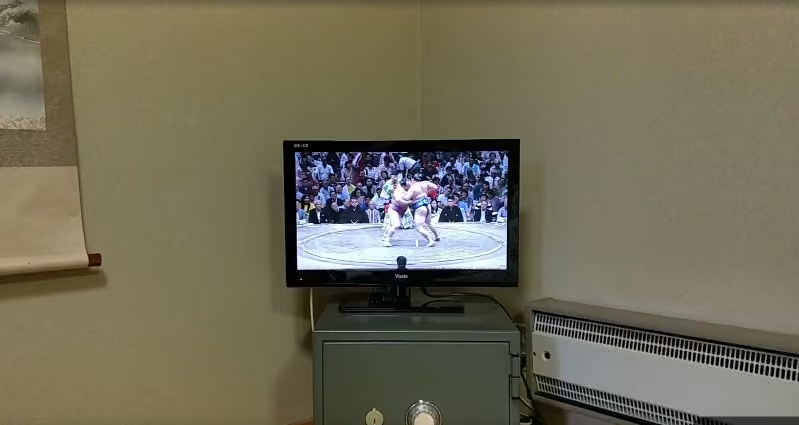 Our room, perfectly preserved, never renovated.
After hiking past small pockets of local homes, you reach an area with open-air hot springs. These baths aren’t for humans, they belong to the monkeys. And boy, are there many of them. They are entertaining to watch; they swim, groom each other, and occasionally fight (not aggressive toward us, unlike in more crowded tourist spots). Tiny babies huddled against their mom is cute.
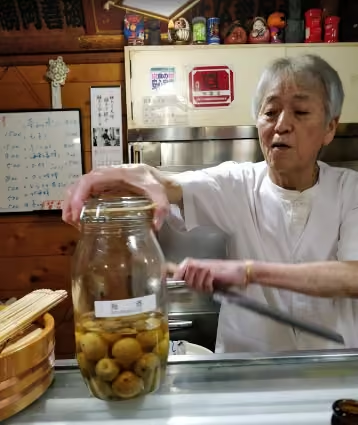 You know it’s the good stuff when it comes in a jar.
As night fell, we went hunting for dinner and settled on a small sushi place. There wasn’t an English menu. It usually means it’s authentic. We sat at the bar and let the Chef/Owner guide us through a fantastic Omakase.
Sitting next to me was an elderly Japanese couple. Now, I am an extremely introverted person; strarting a conversation with strangers is usually terrifying for me. But I wanted to “force my luck.” I realized that nothing happens if you don’t take the first step. Using a mix of broken Japanese and hand gestures, I asked the chef if I could buy my neighbors a round of drinks.
They were surprised at first, but they accepted gladly. Soon, the ice was broken. The chef was so pleased with the atmosphere that he pulled out a special bottle of plum spirit and offered a round to everyone. In the middle of the mountains, surrounded by locals, I felt I was touching some “truth” of Japan. You travel for these small moments of connection, always looking to experience them again.
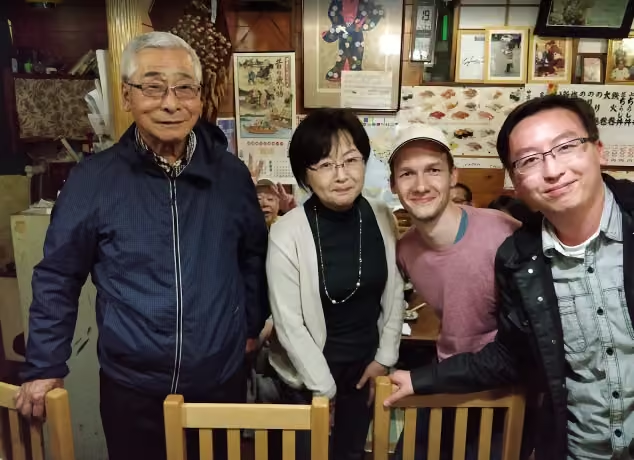 Someone is photo-bombing our dinner.
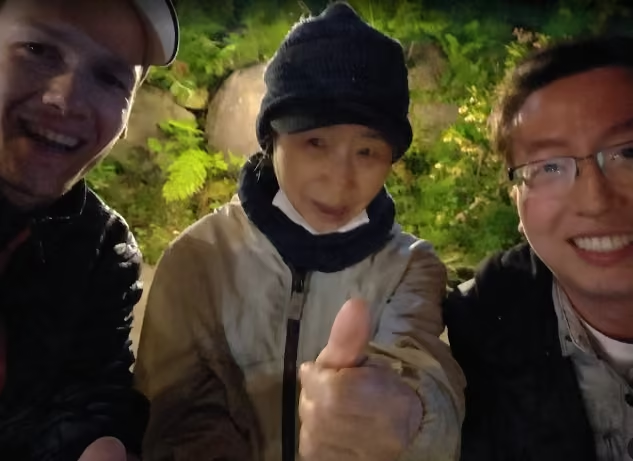
Walking back to our Ryokan, we stopped at a small footbath (ashiyu) in the middle of a public square. An old woman was there, busy with something in the water. We couldn’t figure out what she was doing until she lifted a bottle out of the steaming spring: she was warming her sake in the public bath, just excellent.
Seeing us, she began to chat. We couldn’t understand the words, but gestures and the occasional English word were enough. We took a photo together, and pointing at me, she grinned and said, “Tom Cruise.”
My ego has of course never recovered. We were also quite full of plum liquor by then, which certainly helped our communication skills (even if we weren’t quite as “amped” as our new grandmother friend).
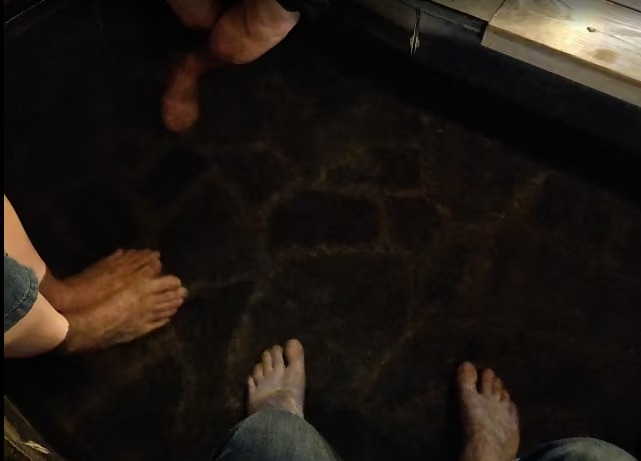 Hot Spring Sake with “Grandma.”
We finished the evening in the Onsen. When I say “we”, I really mean “I”. Not everyone is comfortable with the tradition of being completely naked in front of strangers; my friend opted out. Personally, I don’t mind.
An Onsen is a fascinating social ecosystem. In a village like Yudanaka, this is where the locals come to wash and unwind. You see people of all ages enter, undress, scrub themselves thoroughly while perched on small wooden stools, and then soak in the mineral rich waters. It is a space of relaxation and socialization, and I felt privileged to partake. Even if communication was very hard.
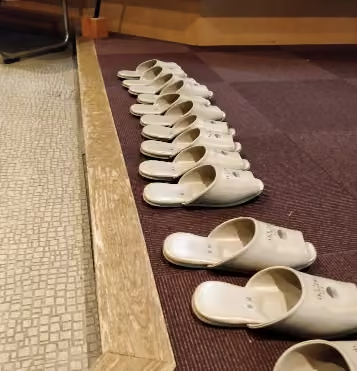 The protocol and etiquette.
Friends often ask me if they should be scared of people being “rude” when they visit France. I think it’s a misconception. French people are social, but we are obsessed with Protocol.
In France, you must say “Bonjour” when entering a shop and “Au revoir” when leaving. If you don’t, you are the one being rude. It is an essential social expectation. Once you acknowledge the protocol, you can try to speak English and people will be happy to help. Every country has these “invisible rules.”
When I started working in Vancouver, Canada, I shook hands with everyone in the office on my first day. On the second day, I did the same. People looked at me like I was crazy. I realized then that in the Canadian office context, there was no expectation for that level of formality. You shake hands the first time you meet, and that’s it. For a Frenchman, that felt like a cold shift, but it was simply a different protocol.
Japan is a land of deep, nuanced expectations. When you travel there, you must respect them. Learning a few words of the language goes a long way; people recognize and appreciate the effort. You aren’t just a customer; you are a guest in their culture.
This is why I prefer the “accidents” of travel over a rigid itinerary. The more “touristy” an area becomes, the more the locals bend to the expectations of the tourists, and the experience loses its soul. I hate booking every hotel in advance. What if I find a place I love? I want the freedom to stay, to linger, and to experience the things I will keep with me for the rest of my life…
…like the kindness of strangers met around a jar of plum wine.